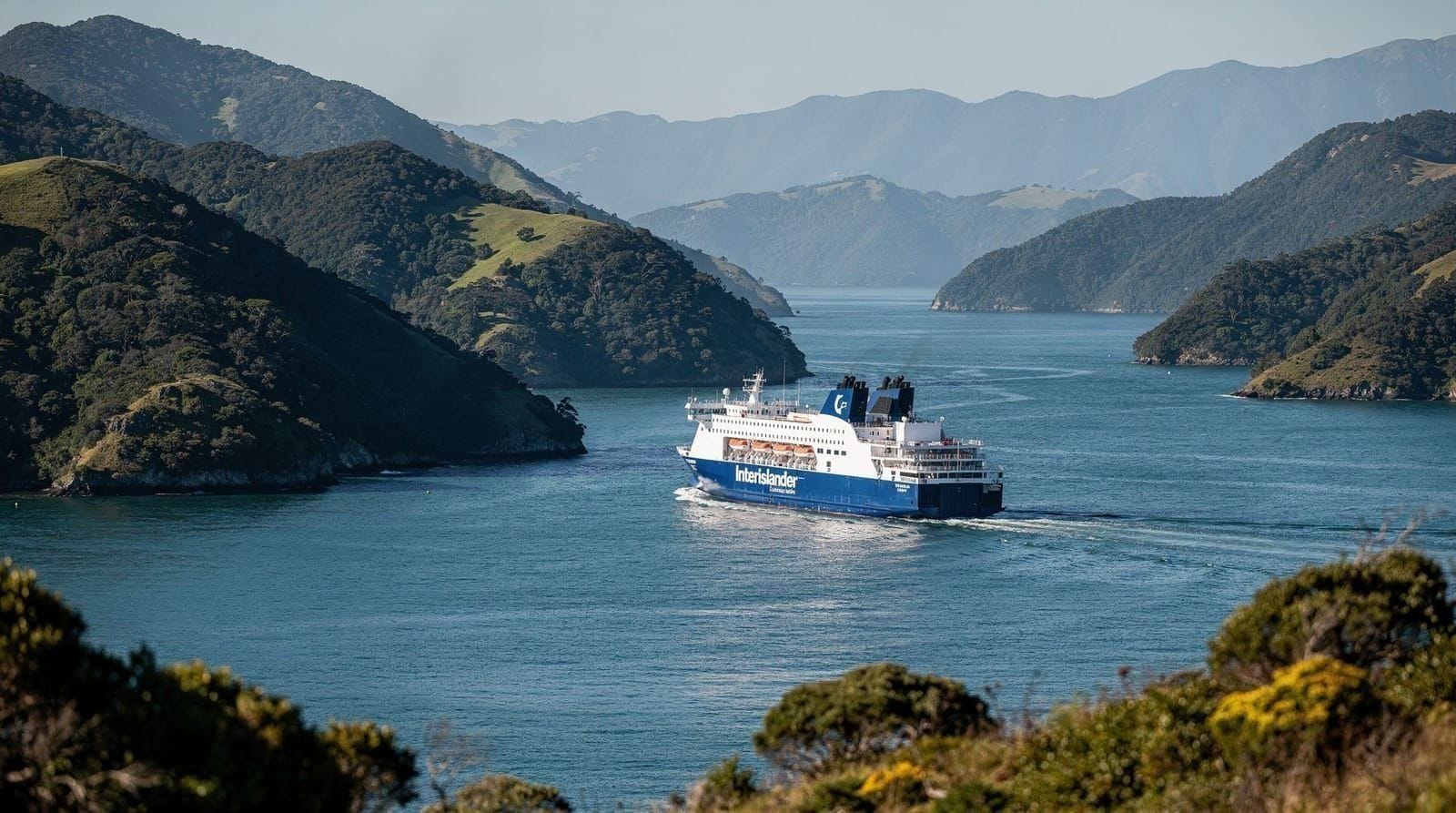
Cook Strait ferry booking pitfalls
Wellington and Picton: Interislander Ferry
Duration: 3.5h
What's the biggest mistake people make booking the Cook Strait ferry?
Scheduling too tight a connection either side of the crossing — a same-day flight, a tour, or a rushed onward drive — without accounting for genuine delay risk. Interislander and Bluebridge sailings are frequently affected by weather, mechanical issues or peak-season congestion, and a 3.5-hour crossing can become a half-day or full-day disruption with little warning.
Why this deserves its own honest guide
The Cook Strait ferry crossing between Wellington and Picton is the single gateway between New Zealand’s North and South Islands for anyone not flying, and it’s a genuinely scenic, worthwhile 3.5-hour journey through open ocean and the Marlborough Sounds. It’s also one of the more common sources of frustration in a New Zealand itinerary, not because the service is badly run, but because visitors routinely book around it in ways that don’t account for its real-world variability. This guide covers the specific mistakes that catch people out, most of which are entirely avoidable with a small amount of planning.
| Route | Wellington to Picton, 3.5 hours dock to dock |
| Operators | Interislander and Bluebridge (separate bookings, separate terminals) |
| Cost | From around NZ$52pp foot passenger; NZ$135-220 with a vehicle |
| Biggest risk | Weather delays, especially in winter — build in a buffer |
| Book ahead | Essential for summer, public holidays, and any car space |
The crossing itself, briefly
Before getting into what goes wrong, it’s worth knowing what the crossing actually involves, since a lot of the pitfalls below stem from misunderstanding it. The Wellington-to-Picton route runs roughly 3.5 hours and passes through open Cook Strait water before entering the sheltered, scenic Marlborough Sounds for the final approach into Picton — genuinely one of the more attractive stretches of the whole journey, and worth staying on deck for if the weather allows. Both Interislander and Bluebridge run multiple sailings most days, though schedules thin out somewhat in winter, and both carry vehicles as well as foot passengers. Our Wellington to the South Island in a week itinerary and interislander ferry review cover the experience itself in more depth if this is your first Cook Strait crossing.
Pitfall 1: booking too tight a connection
The single biggest mistake is treating the ferry like a train that reliably departs and arrives on time, then building a tight connection around that assumption — an onward flight the same afternoon, a tour booked for the moment you’re expected to dock, or a same-day return drive with no buffer. Cook Strait crossings are affected by weather more than most ferry routes globally, given the strait’s exposure to open Pacific and Tasman systems, and delays of one to several hours are a real, recurring possibility rather than a rare edge case.
Build at least a half-day buffer around any hard commitment on either side of a booked sailing, and treat same-day onward flights as genuinely risky unless you’ve built in several hours of slack. This mistake compounds badly with an already tight itinerary — our Kaikōura as a day trip reality check covers the most extreme version of it, where travellers attempt a same-day round trip across the strait and back with essentially no delay buffer at all.
Pitfall 2: not understanding the car booking system
Bringing a vehicle across the strait requires booking your car as a separate line item from your own passenger fare, and it’s priced and capacity-limited independently — a common mistake is assuming a passenger booking automatically includes vehicle space, then discovering at check-in that the specific sailing you wanted is fully booked for vehicles even though passenger seats remain available. Car fares also vary meaningfully by vehicle size and by sailing time, with peak-season and peak-time sailings both pricier and more likely to sell out for vehicle space specifically, well before passenger seats do. Book your car space as early as your dates are confirmed, particularly in summer.
Pitfall 3: assuming Interislander and Bluebridge are interchangeable
Interislander and Bluebridge are separate operators with different terminals, different timetables and, in places, different fare structures — a ticket or booking confirmation for one is not valid on the other, and their Wellington terminals sit in different locations, not within easy walking distance of each other. If a sailing gets cancelled or rescheduled, you generally can’t simply walk over and board the other operator’s next available sailing without a fresh booking and fare. Confirm which operator you’ve actually booked before finalising any tight travel plans, and check the correct terminal location and directions ahead of time rather than assuming they’re interchangeable.
Pitfall 3b: not comparing fares between the two operators
Because Interislander and Bluebridge compete directly on the same route, fares can differ meaningfully between them for a comparable sailing time and vehicle category, and travellers who book with the first operator they find sometimes pay more than necessary for an equivalent crossing. Bluebridge has historically positioned itself as the more budget-friendly option, particularly for night sailings, while Interislander has generally offered a larger vessel with more onboard amenities — a genuine trade-off worth weighing rather than an automatic reason to pick one over the other. Checking both operators’ current fares and schedules before booking, rather than defaulting to whichever comes up first in a search, is a simple step that can meaningfully affect the cost of a family or vehicle booking specifically.
Pitfall 4: underestimating seasickness risk
Cook Strait has a real reputation for rough crossings, and it’s earned — the strait sits between two large islands with no significant landmass to break incoming swell from the open ocean, and even a summer sailing can turn genuinely rough with little warning. Passengers prone to seasickness who assume a calm-looking morning guarantees a smooth crossing are sometimes caught out partway through. Taking motion-sickness medication before boarding (rather than waiting until symptoms start), choosing a seat toward the centre of the vessel where motion is felt least, and getting fresh air on deck rather than staying below in an enclosed lounge are all standard, effective precautions worth planning for regardless of the forecast.
Pitfall 5: booking the cheapest fare without checking what’s included
Both operators sell a range of fare tiers, and the cheapest options sometimes come with fewer amenities, more restrictive change or cancellation terms, or a less comfortable seating category than travellers expect for a 3.5-hour crossing. It’s worth reading exactly what a budget fare does and doesn’t include — particularly the change and refund policy — before assuming the cheapest listed price is automatically the best value, especially if your travel dates carry any real uncertainty.
Pitfall 6: winter and shoulder-season weather risk
Winter sailings carry meaningfully higher odds of delay, rescheduling or outright cancellation due to storm systems, and this risk extends into spring and autumn to a lesser degree. A winter Cook Strait booking without any schedule flexibility is a genuinely higher-risk booking than the same trip in a calmer season, and it’s worth checking a specific operator’s weather-related rebooking policy before committing to non-refundable onward plans around a winter or shoulder-season sailing. Our Kaikōura as a day trip reality check covers a related, extreme version of this mistake — assuming ferry timing works out reliably enough to support an unrealistically tight same-day itinerary.
Pitfall 6b: not accounting for peak-season congestion
Beyond weather-related delays, the crossing sees genuine congestion during New Zealand’s peak summer travel season and around major public holidays, when both foot-passenger and vehicle capacity run close to fully booked well in advance. Travellers who assume a walk-up or last-minute booking will be available, the way it might be in a quieter month, can find themselves without a sailing for a day or more during the busiest weeks of summer. Booking well ahead for any December-to-February travel, and treating a summer Cook Strait crossing with the same advance planning as an international flight rather than a casual local ferry, avoids this specific frustration.
Pitfall 7: not checking in early enough
Both operators recommend arriving well ahead of a scheduled departure — typically 60 minutes for foot passengers and slightly more for vehicles — and late check-in can mean losing your booked sailing entirely, with no guarantee of a seat on the next one, particularly in peak season when sailings can be fully booked days ahead. Wellington’s traffic and parking near the ferry terminal can also eat into your buffer more than expected if you’re driving to the terminal rather than using public transport, so building extra time in on the Wellington side specifically is a sensible habit.
Pitfall 8: assuming the crossing is the whole day’s activity
Some travellers plan a day around “doing the ferry crossing” and nothing else, assuming the 3.5-hour journey itself will feel like a substantial day trip. In practice, once you account for terminal check-in, the crossing itself and disembarkation, you’re left with a genuinely modest window on the other side unless you’ve planned a proper onward destination — Picton, Blenheim or the wider Marlborough region all deserve real time rather than being treated as an afterthought to the crossing itself. Our Picton and Marlborough day trip via ferry guide lays out a version of this that actually works within a single long day.
Pitfall 9: forgetting to plan the onward South Island leg properly
A surprising number of travellers book the ferry crossing itself carefully but leave the onward South Island plan vague, assuming they’ll sort out a rental car or accommodation in Picton on arrival. In peak season this can mean discovering that rental cars in Picton are fully booked, or that Picton’s limited accommodation stock is sold out for the night, precisely because so many other ferry passengers had the same idea. If your onward plan includes Marlborough wine country or a longer South Island loop, book the rental car and at least your first night’s accommodation before you board, not after you land — our Marlborough Sounds cruise guide and Wellington to South Island: 5 days via ferry itinerary both assume this level of advance planning for exactly this reason.
What a well-planned booking looks like
A well-planned Cook Strait booking confirms the specific operator and terminal, books car space (if needed) as early as dates are confirmed, chooses a sailing time with a genuine buffer either side rather than the tightest possible connection, checks the change and refund policy against the season you’re travelling in, and treats winter sailings with extra caution around any non-refundable onward plans. None of this is complicated, but skipping any one of these steps is exactly how the pitfalls above catch people out in practice.
What a delay or cancellation actually looks like in practice
It’s worth knowing what to expect if a sailing is delayed or cancelled, since the process differs from a simple refund in most cases. Both operators typically offer rebooking onto the next available sailing at no extra charge for weather or mechanical cancellations, but “next available” can mean several hours later, or occasionally the next day, if the disruption affects a full day of sailings during a storm system — this is precisely why a tight onward connection is so risky. Compensation for missed onward bookings caused by a ferry delay (a missed flight, for instance) is generally the traveller’s own responsibility rather than the ferry operator’s, since travel insurance rather than the ferry company is the usual channel for that kind of loss. Checking your travel insurance policy’s specific coverage for ferry delays before a Cook Strait crossing with tight onward connections is a sensible, often-overlooked step.
A checklist before you book
Running through a short checklist before finalising a Cook Strait booking catches most of the pitfalls above in one pass: confirm which operator and terminal you’re actually booking; book vehicle space early if you need it, separately from passenger seats; compare fares across both operators rather than defaulting to the first result; check the specific fare tier’s change and refund policy against your travel season; build a genuine buffer around any onward flight, tour or drive; arrive at the terminal well ahead of your scheduled departure; and confirm your onward South Island accommodation and rental car, particularly in peak season. None of these steps takes more than a few minutes, and together they remove nearly all of the risk that catches unprepared travellers out on this specific crossing.
Pitfall 13: not planning for large groups or families
Larger groups and families travelling together sometimes assume seats will simply be available together on a busy sailing, only to find the group split across the vessel on a fully booked crossing, or a rebooking after a cancellation that can’t accommodate everyone on the same later sailing. Booking early and specifically requesting seats together where the platform allows it reduces this risk, and building extra flexibility into the day’s plan is worth it for any group large enough that a partial rebooking would genuinely complicate the day. Families combining the crossing with a longer South Island trip should also read our Wellington to South Island in 5 days itinerary for how a group-friendly version of this trip is typically structured.
Interislander vs Bluebridge at a glance
Since several pitfalls above hinge on the two operators not being interchangeable, it’s worth comparing them directly before booking.
| Interislander | Bluebridge | |
|---|---|---|
| Vessel size | Larger, more onboard amenities | Smaller, more basic |
| Typical price | Slightly higher | Often cheaper, especially night sailings |
| Terminal | Separate Wellington location | Separate Wellington location |
| Best for | Comfort, daytime scenic sailings | Budget-conscious travellers |
Pitfall 12: not knowing the bike and pet policies
Cyclists and pet owners occasionally assume Cook Strait ferry policies mirror domestic flights or match what they’ve experienced on other ferry routes, and get caught out at check-in. Bikes are generally carried for an additional fee and need to be booked alongside your passenger fare rather than assumed to be free extra luggage. Pets typically travel in a designated vehicle-deck area rather than in the passenger lounge with you, and policies differ meaningfully between operators — confirm the specific arrangement when booking rather than assuming it matches a previous ferry experience elsewhere.
Pitfall 10: booking through a third-party site instead of directly
Third-party booking platforms sometimes list Cook Strait sailings alongside flights and other transport, which can be convenient for comparison shopping but occasionally adds a booking fee or makes changes and cancellations more cumbersome than booking directly with Interislander or Bluebridge. If your plans carry any real chance of changing, booking directly with the operator generally gives clearer, faster access to their own change and refund policy rather than routing a change request through a third party first.
Pitfall 11: not confirming the terminal address in advance
Wellington’s Interislander and Bluebridge terminals sit in different locations around the harbour, and travellers occasionally head to the wrong one, especially if working from an old address or a general “ferry terminal” search rather than the specific confirmation email. Double-check the exact terminal address on your booking confirmation the night before, particularly if you’re driving or taking a taxi rather than walking from central accommodation, since a wrong-terminal mistake this close to departure can mean missing the sailing entirely.
Frequently asked questions about Cook Strait ferry bookings
Can I switch between Interislander and Bluebridge if my sailing is cancelled?
Not automatically — they’re separate companies with independent bookings, so a cancelled Interislander sailing doesn’t entitle you to board a Bluebridge sailing without a fresh booking and fare. Each operator handles its own cancellations and rebooking according to its own policy.
How far ahead should I book my car space on the ferry?
As early as your travel dates are confirmed, particularly for summer sailings or specific popular departure times, since vehicle capacity is limited independently of passenger seating and can sell out well before passenger fares do.
Is the Cook Strait crossing usually rough?
It can be, given the strait’s exposure to open ocean swell with little land to break it — even a calm-looking morning can turn genuinely rough. Taking seasickness precautions proactively, rather than waiting to see how the crossing feels, is the more reliable approach.
Should I book a tight same-day connection around the ferry?
No — build at least a half-day buffer around any hard commitment (a flight, a tour, an onward drive) on either side of a booked sailing, since weather, mechanical issues and peak-season congestion all create real delay risk on this specific crossing.
Is winter a bad time to book the Cook Strait ferry?
It carries meaningfully higher odds of delay or cancellation due to storm systems compared with other seasons, though it’s not a reason to avoid the crossing altogether. It is a reason to avoid pairing a winter sailing with tight, non-refundable onward plans.
Do I need to book a rental car for the South Island in advance?
Yes, particularly in peak season — Picton’s rental car availability is genuinely limited relative to the number of ferry arrivals on a busy summer day, and travellers who wait until they’ve landed sometimes find nothing available. Booking your onward car alongside your ferry ticket is the safer approach.
What happens to my ticket if I miss my sailing due to a late arrival at the terminal?
Policies vary by operator and fare tier, but a genuinely late arrival can mean forfeiting the fare entirely under the cheapest ticket types, or paying a rebooking fee under more flexible fares. Arriving with the recommended buffer before departure is the simplest way to avoid this situation altogether.
Should I choose Interislander or Bluebridge?
Neither is objectively better across the board — Interislander generally runs larger vessels with more onboard amenities, while Bluebridge has traditionally positioned itself as the more budget-friendly option, especially for night sailings. Comparing current fares and schedules for your specific dates is more useful than a blanket recommendation either way.
Is travel insurance worth it specifically for the ferry crossing?
Given the genuine risk of weather-related delays affecting onward connections, yes — travel insurance that explicitly covers ferry delays and missed connections is a sensible, inexpensive safeguard for any itinerary with a tight schedule either side of a Cook Strait booking.
Does travelling with children change any of these booking considerations?
Mainly around seasickness precautions and vehicle booking — families travelling with a car should book vehicle space especially early given more limited capacity, and it’s worth discussing motion-sickness precautions with children in advance rather than waiting until symptoms appear partway through the crossing.
Can I bring a bike or a pet on the Cook Strait ferry?
Generally yes, but both require booking ahead as a separate item rather than being treated as free extra luggage or carried in the passenger lounge — bikes typically incur an additional fee, and pets travel in a designated vehicle-deck area. Confirm the specific policy with your chosen operator when booking rather than assuming it matches a previous ferry experience.